


What is the Best Vegan Supergreens Powder?

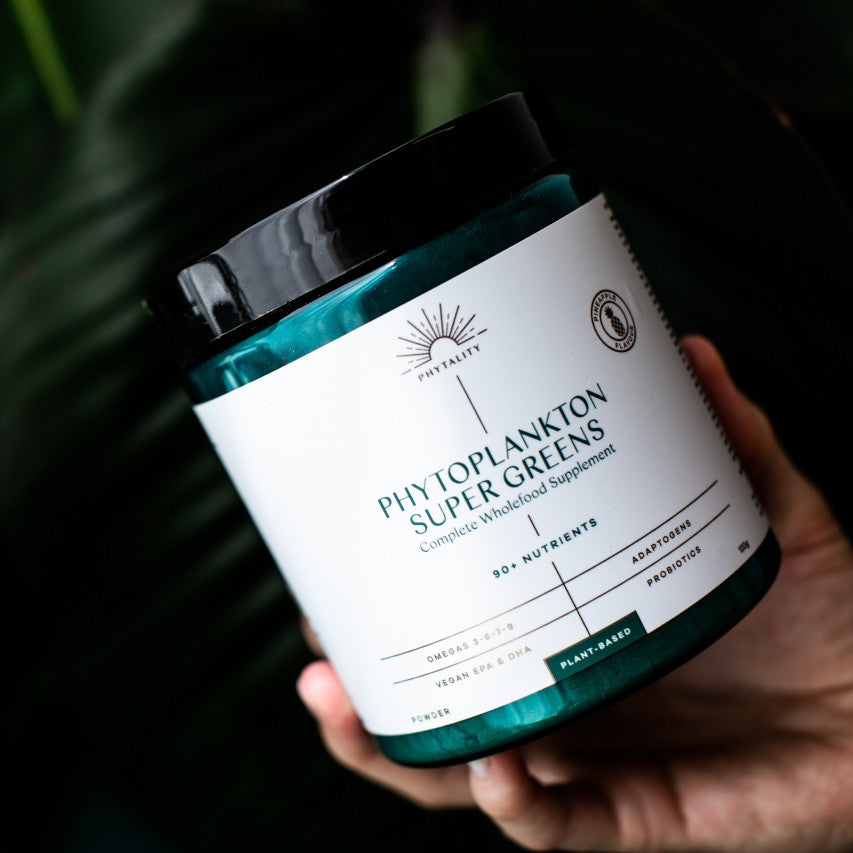
Most supergreens powders are vegan by default. They're blends of dried grasses, algae, and plant extracts. But if you're relying on a greens powder to cover genuine nutritional gaps in a plant-based diet, you'll notice that most of them miss the one thing vegans actually struggle to get enough of: long-chain omega-3 fatty acids.
That's the difference between a supergreens powder that happens to be vegan and one that's formulated with vegan nutrition in mind. If you've ever stood in front of a shelf of greens powders trying to work out which one does more than just tick the "plant-based" box, this guide is for you.
Why Most Vegan Supergreens Powders Fall Short on Omega-3
What Standard Greens Powders Deliver
A typical supergreens blend gives you wheatgrass, barley grass, spirulina, and chlorella. These are genuinely nutrient-dense ingredients. You'll get chlorophyll, iron, B vitamins, and a broad spread of micronutrients. No complaints there.
But here's what you won't find in most of them: EPA. That's eicosapentaenoic acid, one of the two long-chain omega-3 fatty acids your body uses directly for normal heart function. The other is DHA. Both contribute to the normal function of the heart at a combined daily intake of 250 mg, per EU Regulation 432/2012.
The ALA-to-EPA Conversion Problem
If you're vegan, your dietary sources of omega-3 are mostly ALA (alpha-linolenic acid) from flaxseed, chia, and walnuts. ALA is an essential fatty acid, but your body needs to convert it to EPA and DHA before it can use it for those functions. Research indicates this conversion is limited, with estimates ranging from around 5-10 per cent for EPA and lower still for DHA.
That means even a generous daily intake of flaxseed may leave you well short of meaningful EPA and DHA levels. We set the figures out in our ALA vs EPA vs DHA comparison.
This isn't a scare story. It's a straightforward gap in plant-based nutrition that most greens powders simply don't address. They give you the grasses and the algae, but they stop short of solving the omega-3 problem.
How Marine Phytoplankton Changes What a Supergreens Can Deliver
Marine phytoplankton are single-celled microalgae that sit at the base of the ocean food chain. They're the original source of omega-3 in the marine ecosystem. Fish don't produce EPA and DHA themselves; they accumulate it by eating organisms that feed on phytoplankton. Going to the source cuts out the middleman entirely.
The species Nannochloropsis, in particular, is naturally rich in EPA. Published lipid analyses show that EPA constitutes a significant proportion of its total fatty acid content. That makes it one of the few plant-based ingredients that delivers EPA directly, without relying on your body's limited ALA conversion pathway.
For you as a vegan, this matters practically. Instead of taking a greens powder and a separate algae oil capsule, you get EPA-containing phytoplankton built into the blend. It's one less bottle on the shelf and one less thing to remember before you leave the house.
What's in Phytality's Supergreens Powder
We formulated our Phytoplankton Supergreens to address the gaps we kept seeing in existing blends. The base includes wheatgrass, barley grass, and spirulina for the broad micronutrient foundation you'd expect. But the formulation decisions that matter are the ones beyond that baseline.
We chose to include our ULTANA multistrain phytoplankton powder for the EPA content. We added fermented chlorella because the fermentation process breaks the cell wall, which makes the nutrients inside more accessible to your digestive system. We included ashwagandha root and a probiotic blend because, honestly, if you're going to take one powder each morning, it should cover as much ground as it reasonably can.
The trade-off is that a multi-ingredient blend means each individual ingredient appears at a lower dose than you'd get from a standalone supplement. If your primary concern is maximising EPA intake specifically, a dedicated algae oil will deliver a higher concentrated dose. Our supergreens is designed as a broad daily foundation, not a high-dose omega-3 supplement.

|
ULTANA Phytoplankton Whole-cell marine phytoplankton grown in closed photobioreactors. EPA omega-3, chlorophyll, and carotenoids. From £42.97 | View product |
Taste, Cost, and the Daily Routine
You know the reality of greens powders. Most of them taste like pond water blended with grass clippings. We use a natural pineapple flavour that genuinely shifts the experience. It won't taste like a smoothie from your favourite cafe, but it's pleasant enough that you'll actually drink it rather than letting the tub gather dust at the back of the cupboard.
On cost: we've priced the supergreens at roughly half of what you'd pay for some of the more heavily marketed greens powders on the market. Whether that comparison holds depends on your serving size and how long a tub lasts you, so check the per-serving maths for your own usage.
If you've looked at premium greens powders and felt the price was hard to justify, you'll find this lands in a more accessible range.
The practical test is simple. Can you mix it into water or a smoothie every morning without dreading it? Does it stay in your routine past the first week? For most people, taste and cost are the two things that determine whether a supplement actually gets used or just sits there.
What to Look for in Any Vegan Supergreens Powder
If you're comparing options, here's what we'd suggest you check on the label:
- Does it contain EPA or DHA directly? ALA-only sources (flax, chia) require conversion. If the blend doesn't include a direct EPA or DHA source like phytoplankton or algae oil, it's not solving the omega-3 gap.
- Is the chlorella fermented or broken cell wall? Standard pulverised chlorella has an intact cell wall that can limit nutrient access. Fermented or broken cell wall chlorella addresses this.
- What's the per-serving cost? A cheaper tub with a tiny scoop isn't necessarily better value, so work out the daily cost against the recommended serving before you compare two prices.
- Are the ingredients sustainably sourced? In our assessment, land-based cultivation of microalgae avoids the concerns around ocean contamination and marine ecosystem disruption that come with fish-derived ingredients. Look for producers who can tell you where and how their ingredients are grown.
No single powder will replace a well-planned diet. But if you're vegan and you want a daily supplement that goes beyond basic greens to address real nutritional blind spots, the ingredient list is where you'll find the answer. Our guide to what to look for in a greens powder takes the label check further.
Sources
- Burdge GC, Wootton SA. Conversion of alpha-linolenic acid to eicosapentaenoic, docosapentaenoic and docosahexaenoic acids in young women. Br J Nutr. 2002;88(4):411-420. PubMed
- Welch AA, Shakya-Shrestha S, Lentjes MAH, Wareham NJ, Khaw KT. Dietary intake and status of n-3 polyunsaturated fatty acids in fish-eating and non-fish-eating meat-eaters, vegetarians, and vegans: results from the EPIC-Norfolk cohort. Am J Clin Nutr. 2010;92(5):1040-1051. PubMed
- Commission Regulation (EU) No 432/2012 establishing a list of permitted health claims. Official Journal of the EU. L 136/1. EUR-Lex
Cara Hayes, MSc Nutrition and Dietetics (University of Sydney), writes all content in the Phytality Knowledge Centre. Read our editorial policy.
This article is for informational purposes only and is not a substitute for professional medical advice, diagnosis, or treatment. Consult your GP or a qualified healthcare professional before starting any supplement.
Methodology and Disclosure
Phytality manufactures the supergreens powder discussed here and has a direct commercial interest in this article. Nutrient function statements are EFSA-authorised claims cited with their intake conditions under Commission Regulation (EU) No 432/2012. ALA conversion figures reflect published conversion studies.
Ingredient quantities describe our own product specification. Price comparisons reflect UK retail pricing at the time of review and shift with pack size and promotions, so check the per-serving figure yourself.
Last reviewed: August 2026
From the Phytality range
|
|

|

|


